With UK domestic energy costs remaining a key concern for homeowners in 2026, particularly those reliant on oil-fired heating, this study presents key insights from a detailed analysis originally conducted in 2022 for a typical 173 m² detached family home in a typical UK climate (temperate climate with warm summers). The analysis remains highly pertinent today, demonstrating how targeted retrofits—improved air tightness, system upgrades, and solar integration—can achieve substantial reductions in operational costs (over 50%) and greenhouse gas emissions (nearly 70%).
The study employed rigorous energy modeling to compare five scenarios against the baseline oil boiler system, providing evidence-based guidance for similar properties considering low-carbon transitions.
Property Overview and Modeling Assumptions
The subject dwelling is a two-story detached house featuring a pitched tiled roof, cavity walls (with insulation in extensions), double-glazed uPVC windows, and southwest/northeast orientation—favorable for solar capture.

Existing system: 25 kW oil-fired combi boiler (70% efficiency) with radiators. The proposed layout incorporates an open-plan kitchen/dining/living area, lounge, study, bedrooms, bathrooms, garage, and covered patio.
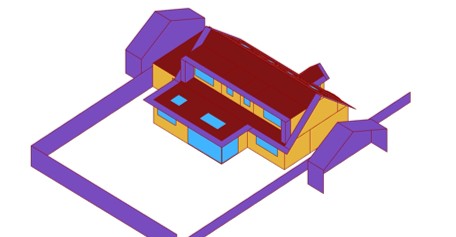
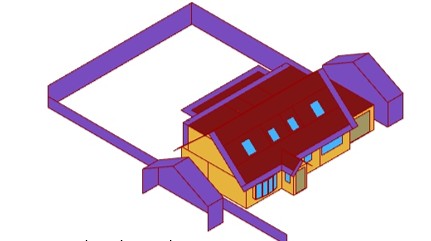
The energy model incorporated local climate data, fabric characteristics, internal gains, and realistic operational profiles. A key disclaimer: modeling offers comparative insights rather than exact predictions, as actual performance depends on usage, weather variability, and maintenance.
Simulated Retrofit Scenarios
All scenarios incorporated enhanced air tightness to 5 m³/hr/m² at 50 Pa, significantly reducing infiltration losses. The five cases evaluated were:
- Scenario 1 (Baseline): Existing oil boiler with radiators.
- Scenario 2: New high-efficiency oil boiler + improved air tightness.
- Scenario 3: Electric boiler + improved air tightness.
- Scenario 4: Air source heat pump (ASHP) with radiators + improved air tightness.
- Scenario 5: Electric storage radiators (off-peak operation) + improved air tightness.
The ASHP scenario consistently demonstrated superior performance due to its high coefficient of performance (COP), often exceeding 300% efficiency in suitable conditions.
Simulation results (without solar) highlight dramatic reductions in annual energy use and costs:

Heating remains the dominant load (red), but the ASHP scenario cuts total consumption to 7,419 kWh/year from 18,734 kWh in the baseline.
Detailed Heat Pump and Radiator Sizing
Room-level heat loss calculations ensure appropriate system capacity, avoiding inefficiency from oversizing. Total radiator output required: 16,808W.
Heat pump recommendation: 17 kW for space heating; 20 kW including domestic hot water.
Sizing excerpt:
| Zone | Area (m²) | Total Zone Heat Loss  | Heat Size Required | Radiator Size |
|---|---|---|---|---|
| Bath 1 | 5.76 | 202.67 | 486.4 | 488.0 |
| Bath 2 | 3.35 | 117.64 | 282.3 | 286.0 |
| Bath 3 | 4.73 | 156.25 | 375.0 | 378.0 |
| Bedroom 1 | 14.24 | 615.15 | 1476.4 | 1477.0 |
| Bedroom 2 | 22.03 | 722.07 | 1733.0 | 1732.0 |
| Bedroom 3 | 21.24 | 652.35 | 1565.6 | 1568.0 |
| Hall 1 | 12.61 | 142.95 | 343.1 | 373.0 |
| Hall 2 | 8.74 | 191.04 | 458.5 | 454.0 |
| Kitchen/ Dining/ Living | 44.71 | 2836.94 | 6808.6 | 6818.0 |
| Lounge | 18.68 | 696.93 | 1672.6 | 1683.0 |
| Study | 12.14 | 567.16 | 1361.2 | 1361.0 |
| Store | 2.44 | 59.57 | 143.0 | 190.0 |
| Total | – | – | – | 16,808 |
This precision supports reliable performance across design conditions.
Integrating Solar PV: Enhanced Operational Savings
Solar energy harnesses the sun’s abundant power through photovoltaic (PV) panels, which convert sunlight directly into electricity via the photovoltaic effect. When photons from sunlight strike silicon cells within the panels, they excite electrons, generating direct current (DC) electricity. An inverter then transforms this DC into alternating current (AC) suitable for household use, powering appliances, lighting, or feeding excess back to the grid. In residential settings, such as the analyzed southwest-facing roof, significantly offsets operational costs—especially when paired with efficient systems like air source heat pumps—while reducing reliance on fossil fuels and cutting greenhouse gas emissions.
The southwest-facing roof accommodates six 410 W panels (2.46 kWp), yielding an estimated 1,837 kWh annually (~306 kWh per panel).
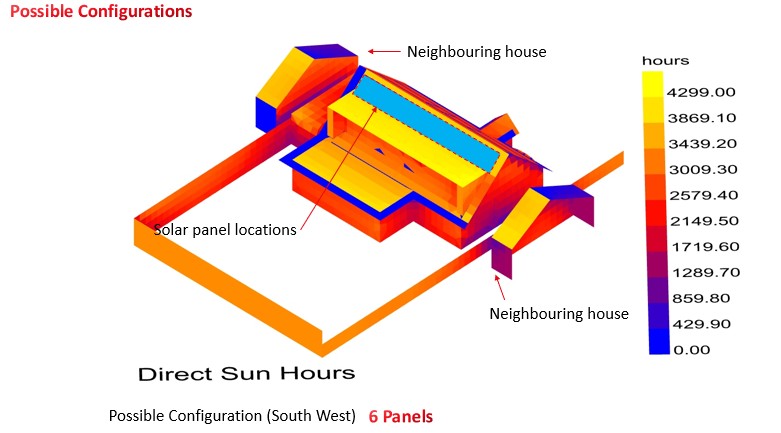
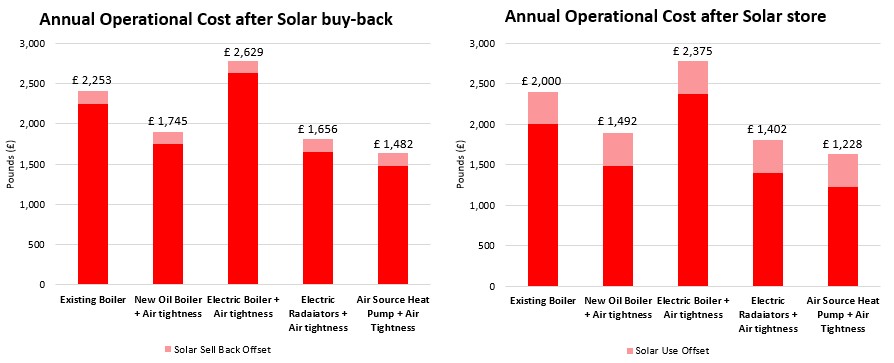
Export at ~8.2p/kWh or battery storage maximizes benefits. Combined with ASHP + air tightness:
- Solar export offset: costs ~£1,482/year
- Solar self-consumption/storage: costs ~£1,228/year
This represents >55% savings versus the baseline oil system.
Solar irradiation modeling confirms optimal panel placement despite minor shading from neighboring structures.
Environmental Outcomes and Carbon Reduction Potential
Baseline emissions: ~4.1 MTCO₂/year. The optimal retrofit pathway (ASHP + solar + fabric improvements) reduces this to ~1.2 MTCO₂/year—a ~2.9 MTCO₂ saving.

Equivalents include avoiding ~7,198 miles of average car travel annually or recycling 1 ton of waste instead of landfilling.
Implications for UK Residential Retrofits in 2026
This simulation-based comparative study underscores the technical and economic viability of ASHP retrofits combined with solar PV and basic fabric enhancements. For oil-dependent homes, these measures offer a pathway to lower bills, enhanced thermal comfort, and alignment with net-zero goals—supported by ongoing incentives like the Boiler Upgrade Scheme.
Professional energy assessments remain essential to tailor solutions to individual properties.
What aspects of residential energy retrofitting interest you most—heat pumps, solar integration, or fabric upgrades? Share your thoughts below!
Need a bespoke energy model for your property? Get in touch with us at info@smart-energy-solutions.uk or call us at +44 1624 621436
 Powering Our Building
Leave a comment